Breadth First Search (BFS) Traversal – Graph | C++
BFS (Breadth First Search) is one of the most important graph traversal algorithms. It explores nodes level by level using a queue (FIFO). Very common in interviews at companies like :contentReference[oaicite:0]{index=0}, :contentReference[oaicite:1]{index=1}, :contentReference[oaicite:2]{index=2}.
Problem Statement
Given an undirected connected graph represented using adjacency list, return BFS traversal starting from vertex 0. Traverse neighbors in the same order as given.
Intuition
- Use Queue (FIFO)
- Visit node → push neighbors
- Mark visited to avoid cycles
- Process level by level
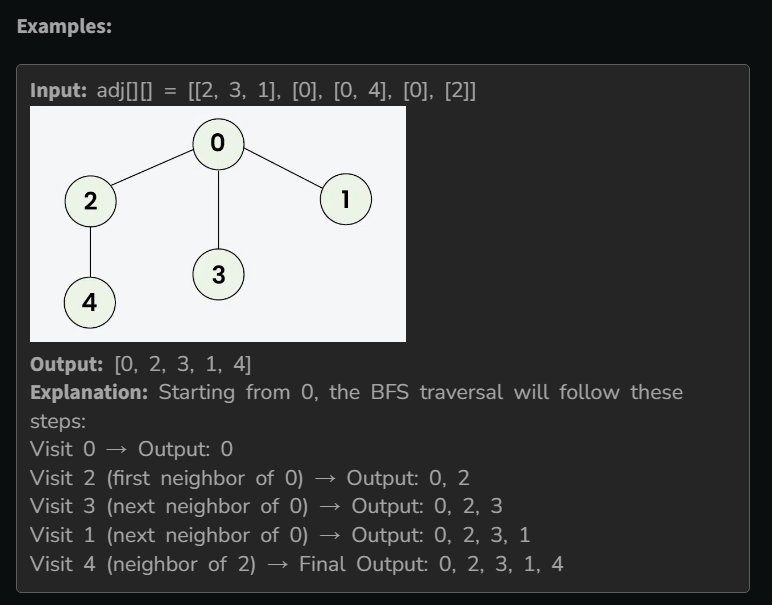
Source: geeksforgeeks.org
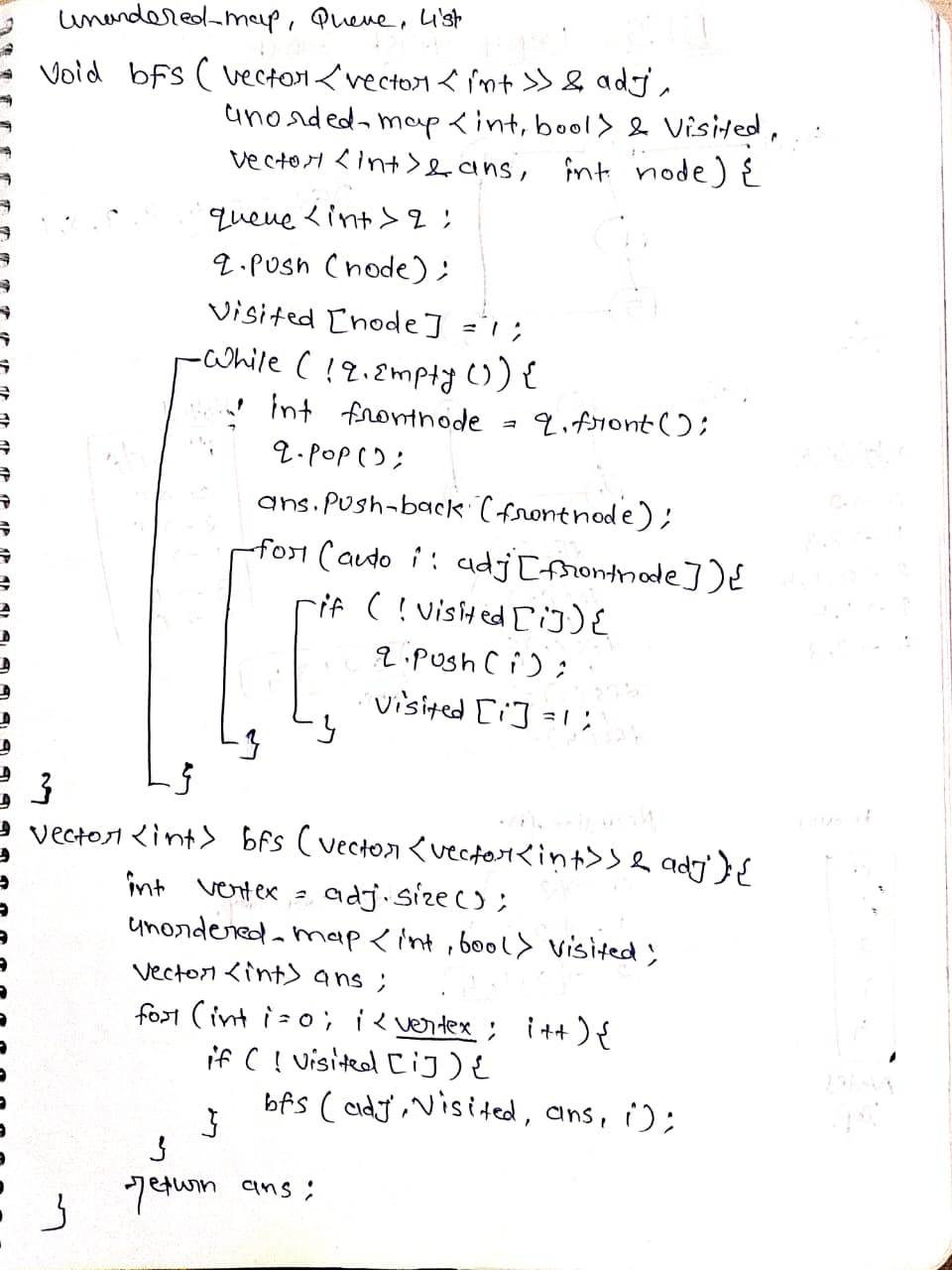
Handwritten Notes
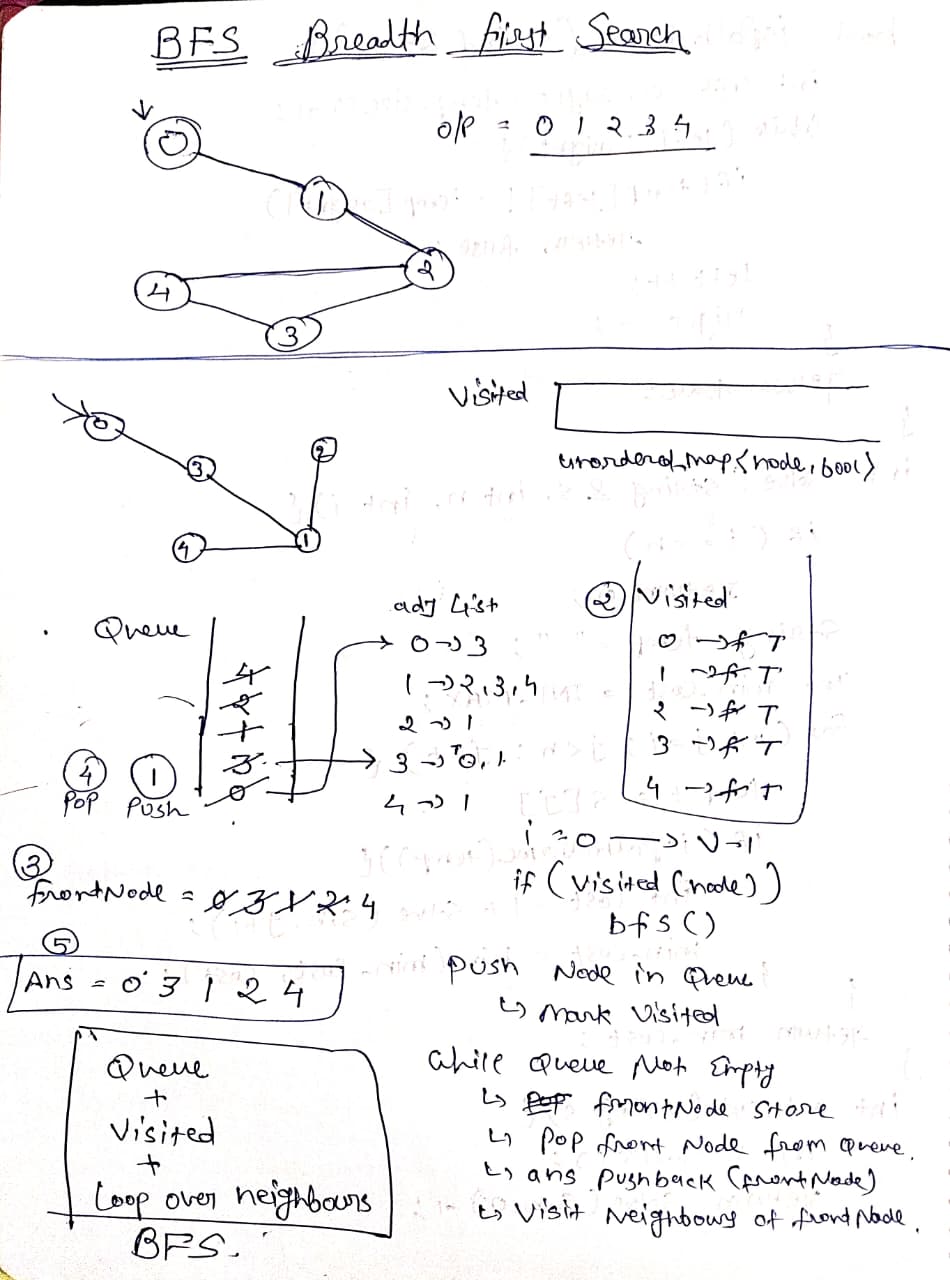
Dry Run Example
adj = [[2,3,1], [0], [0,4], [0], [2]]

Start → 0
Queue → 2,3,1
Then → 4

Output → 0 2 3 1 4
Approach
- Push start node (0) into queue
- Mark visited
- While queue not empty → pop and explore neighbors
- Add unvisited neighbors
Time: O(V + E)
Space: O(V)
C++ Code
class Solution {
public:

    void bfsHelper(vector>& adj,unordered_map& vis,vector& ans,int node) {

        queue q;

        q.push(node);
        vis[node] = true;

        while(!q.empty()) {

            int frontnode = q.front();
            q.pop();

            ans.push_back(frontnode);

            for(auto i : adj[frontnode]) {
                if(!vis[i]) {
                    q.push(i);
                    vis[i] = true;
                }
            }
        }
    }

    vector bfs(vector>& adj) {

        int vertex = adj.size();

        unordered_map vis;
        vector ans;

        for(int i = 0; i < vertex; i++) {
            if(!vis[i]) {
                bfsHelper(adj, vis, ans, i);
            }
        }

        return ans;
    }
};
Graph BFS Queue C++